Persecuted Convert Warns: Vatican Silence on Islam Driving Europe Toward “Self-Annihilation”
“If the Vicar of Christ does not speak out against the persecution of Christians, who on earth still can?”

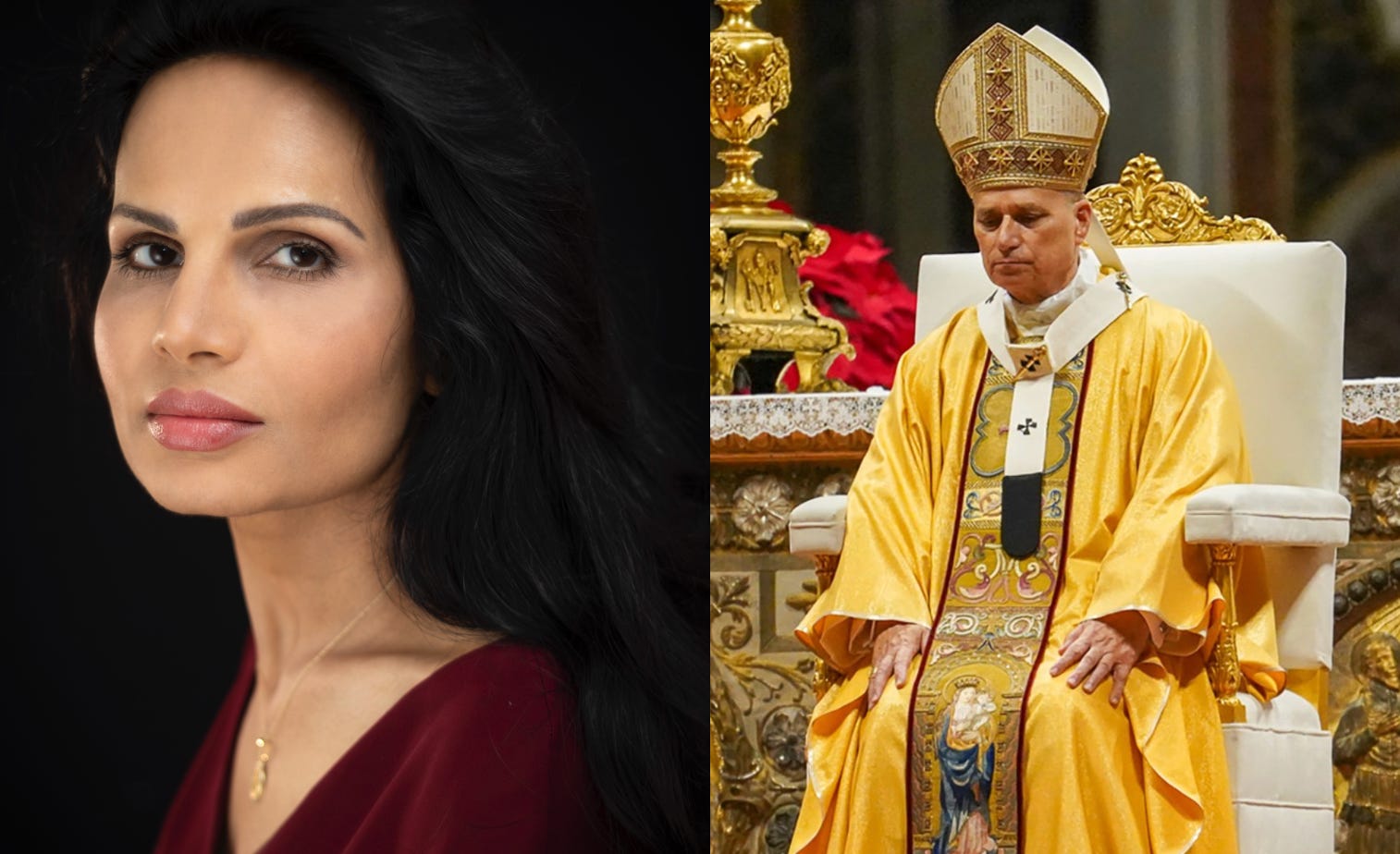
ROME, 26 December 2025 — A Muslim-born Catholic convert living in exile in the U.S. is warning that the Vatican’s approach to Islam is putting Christians worldwide at risk. She is also urging Pope Leo XIV to take stronger action against their persecution.
Sabatina James, an Austrian‑Pakistani humanitarian and author of the new memoir The Price of Love: The Fate of a Woman and a Warning to the West, fled Germany in 2015 amid ongoing death threats for apostasy and her outspoken criticism of forced marriage.
Born into a devout Muslim family in Pakistan, after moving to Austria with her family, she converted from Islam to Catholicism and has devoted her life to freeing Christian slaves, protecting orphans, and rescuing women and girls from forced marriage and honor-based violence.
In this in-depth interview, she contends that European leaders are steering the continent toward “self-annihilation” and argues that the Catholic Church has abetted this trajectory by emphasizing “mercy” toward refugees, failing to confront the realities of Islam, and neglecting to preach and uphold the faith that shaped European culture. She further warns that the same fate could reach the United States if its leaders do not heed these warnings.
Indiscriminately accepting Muslims while ignoring violent Islamism is “indefensible,” James says. “A public correction of these misguided attitudes is urgently needed, and it needs to come from the Catholic Church.” Failure to do so, she says, makes its leaders “complicit in Islamist violence.”
Recalling Benedict XVI’s apology to the Muslim world following backlash to his 2006 Regensburg address, she contends that Pope Francis “sacrificed the persecuted on the altar of interreligious dialogue” and that Pope Leo XIV has, in the first months of his pontificate, effectively implied that the Christian world ought to “accept or ignore abuses” being perpetrated by Islamists across Europe.
“If the Vicar of Christ does not speak out against the persecution of Christians, then who on earth still can?” she asks, and calls on the new pontiff to step up to support and defend the persecuted.
In this interview, Sabatina James also discusses some of the most dramatic cases her charitable foundation has encountered in countries such as Pakistan, her perspective on the persecution of Christians in Nigeria—where U.S. military, on Christmas night, carried out lethal attacks on ISIS terrorists—and why she has sent copies of her new memoir to all the bishops of the United States.
Here is my interview with Sabatina James, on the feast of St. Stephen, Protomartyr.
Diane Montagna (DM): In your new book, The Price of Love, you describe your life in the United States as one of “exile.” What led you to flee Europe, and more specifically, Germany?
Sabatina James (SJ): I fled from Islam in Germany. The permanent, uncontrolled immigration of millions of people from Islamic countries, including an incalculable number of violence-prone Muslims, combined with almost daily media reports of rape and murder, represents a serious escalation of security risks for Europeans. In my case the escalation compounded the public death threats I was receiving from various Muslims both online and in the streets. While Salafists and Hamas supporters can walk freely on the streets of London, Berlin and Vienna, I—someone who integrated into society and defended Europe’s freedoms—was forced to flee.
(DM): German Cardinal Gerhard Müller recently said that “in twenty to thirty years, Islam could become the dominant religion” in Germany. Is Europe committing suicide?
(SJ): Europe is undergoing a process of intentional self-annihilation. Its political leaders have sealed the continent’s fate through unchecked mass migration, deliberately choosing to replace the coming generations with Muslims. The Church has aided them in this endeavor with talk of “mercy” towards refugees, while justice for Europeans has been sidelined. And perhaps the bell would not have tolled with such finality, had Europe held fast to its ancient faith. Yet in religion’s stead, each person determines his own morality and subjective truth. Christianity is viewed as superfluous to true ethics and human rights.
One might even argue that the European elite—in politics, media, and beyond—are relentlessly pressing and manipulating the population toward surrender, even self-erasure, thereby igniting the fierce counterfire of a surging populism they themselves provoked. They must explain the reason for such folly. A German economist once remarked on former Chancellor Merkel’s inexplicably destructive migration policies: “Either she has lost her mind, or she pursues some hidden agenda unknown to us.” This is compounded by the tendency of the so-called elite to converse chiefly among their own kind, insulated from the concerns and reflections of ordinary citizens—a detachment that serves to bolster their one-sided dominance.
Wolfgang Kubicki, the former liberal vice president of the German Bundestag, who authored the book Meinungsunfreiheit (Unfreedom of Opinion), observed that whereas people once exchanged arguments to find the truth, they now discredit the people who make arguments so that no one has to address the arguments themselves. This tactic was rightly condemned by US Vice President J.D. Vance in his memorable address in Europe. And this was precisely the point of President Trump’s recent warning: Look at Germany, see what they have done there, and know what awaits us should we fail to alter course — irrespective of whether one agrees with every step he has taken.
What does Islam teach about Christians?
The Quran (Surah 98:6) describes Christians and other non-believers as being among “the worst of creatures.” It further teaches that committed Muslims must fight Christians until they submit, simply because they do not believe in Allah and his messenger. This message is articulated particularly clearly in Surah 9, which contains some of Muhammad’s final instructions to his followers.
That’s why groups like ISIS and Al-Qaeda—who aim to model themselves strictly on Muhammad’s example—treat these verses as direct commands. Within traditional Islamic teaching, strategy plays a key role: when Muslims are a minority, their approach is often peaceful and cooperative. However, once sufficient power is attained, history shows that Christians and other non-Muslims have frequently faced violent subjugation.
This pattern explains how the Middle East, where Christianity flourished and remained the dominant religion for nearly a thousand years, gradually became overwhelmingly Muslim. It also explains why the Catholic Church spent more than 1,300 years actively defending Christian lands and communities against Islamic expansion.
Let’s turn to the Catholic Church’s stance towards Islam today. During his first inflight press conference, on his return from Turkey and Lebanon, Pope Leo XIV was asked by a French journalist if Catholics in Europe who believe that Islam is a threat to the West’s Christian identity are right, and what he would say to them. The Pope responded that while fears about immigration exist in Europe, they are often fueled by those opposed to immigration who seek to exclude people from different countries, religions, or races. He said his experience showed that dialogue, respect, and peaceful coexistence—especially between Muslims and Christians—are not only possible but already taking place.[1] As a convert from Islam to Catholicism, what is your view on Pope Leo XIV’s remarks?
It is understandable that the Holy Father does not wish to criticize Islam while visiting the Muslim world. After all, the Church long ago laid down her arms before Islam. Members of the Church hierarchy are acutely aware that even mild criticism of Islam can provoke a storm—a lesson painfully underscored after Pope Benedict XVI’s 2006 Regensburg address, in which he quoted a fourteenth-century Byzantine emperor who criticized Islam saying: “Show me just what Mohammed brought that was new, and there you will find things only evil and inhuman, such as his command to spread by the sword the faith he preached.”
The Regensburg address sparked one of the strongest global reactions to a modern papal speech, prompting the Vatican to express regret that Muslims were offended. Pope Benedict later said he was “deeply sorry” for the reactions, stressing that the cited medieval text did not reflect his views and that the speech was intended to encourage respectful, sincere dialogue.
Yes, but across the Islamic world, riots erupted; crosses were burned, churches smoldered, and blood was spilled in places where the Pope’s words had never even been heard. An elderly nun was murdered in Somalia. What followed was revealing: instead of defending his remarks, Benedict, as you note, expressed that he was “deeply sorry” for offending the sensitivity of Muslims, and within months he was praying inside the Blue Mosque in Istanbul. The message, even from that holy Pope, was unmistakable: the Church lacked the courage to confront Islam.
Benedict’s successor took note. Pope Francis did not speak out against the death penalty for Christians who leave Islam to embrace Christianity in Iran or against Pakistan’s blasphemy laws. Instead, he sacrificed the persecuted on the altar of interreligious dialogue. But none of this alters the underlying reality of Christian persecution. It is undeniable that Christians are actively being persecuted in the name of Islamic Sharia—though, presumably, not all Muslims support this. But disagreeing with it does not erase the reality, nor does it give anyone the right to deny the persecution or recast it as something virtuous.
When conversion from Islam to Christianity is punished with prison, flogging, or execution, we are confronted with a grave and utterly unacceptable assault on the human right to religious self-determination. It is also a direct attack on the peaceful coexistence of religions—an attack that Muslims themselves would scarcely tolerate if the tables were turned and converts to Islam in the West were being imprisoned, whipped, or killed.
And there are the parallel offences: blasphemy laws, rape without punishment, the legal disparity between a Muslim man and a Muslim woman, and so on.
What course of action should the Catholic Church advocate, particularly in Western nations?
If Islamists insist on promoting and enforcing the violent dictates of Sharia, it is not merely appropriate but imperative to oppose them openly, to prevent their entry into the West, and, when necessary, to send them back. Failure to do so makes one complicit in Islamist violence, violence aimed at Christians, Jews, atheists and other non-Muslims alike. Such complicity makes one not only an adversary of the Christian faith but also of fundamental human rights.
A naïve policy of indiscriminate acceptance of Muslims into the West, while turning a blind eye to violent Islamism, is simply indefensible. A public correction of these misguided attitudes is urgently needed, and it needs to come from the Catholic Church, whom Jesus Christ has established to be a light to the nations.
Of course, there are Muslim victims of Sharia, individuals who, by defending the human rights of other faiths or speaking openly about Sharia’s abuses, face genuine danger from Islamist persecution. These people may indeed deserve refuge in the West, especially if they risk renewed persecution elsewhere in the Islamic world—though paradoxically, they are often the very ones least likely to be granted entry.
Yet the claim that all Islamic countries are uniformly so intolerable that no Muslim could reasonably be returned to any of them is an insult of profound magnitude to the Islamic world and cannot be accepted. After all, Article 12 of the Declaration on Human Rights in Islam—unanimously endorsed by all 57 OIC [Organization of Islamic Cooperation] member states—guarantees Muslims the right to asylum throughout the Islamic world.
The burden of change does not lie primarily with the Christian world, which is under no obligation to “learn” to accept Islamist violence. The responsibility rests with the Islamic world, which must confront and eradicate such violence.
The Pope’s travels into the Islamic world to advocate for peaceful coexistence can indeed be a worthy endeavor, even if diplomatic caution is favored over direct confrontation. But to imply that the Christian world should accept or ignore abuses—as Pope Leo appears to have done in his inflight press conference—so that Islamist violations of human rights or acts of violence go unchallenged, is entirely different. That approach not only betrays the victims and enables the deniers; it also stands in direct opposition to Scripture, which warns in Malachi 3: “Woe to those who call evil good and good evil.”
Pope Benedict XVI famously said in 2007 that the West is suffering from a “pathological self-hatred,” that Europe is no longer able to perceive what is “great and pure” about its own culture, and that it will not survive without embracing its own “heritage of the sacred.”[2] Is it not necessary, in the face of Islam’s growing influence, for the Church to courageously and unwaveringly reclaim her own faith, doctrine, and liturgical heritage.
If the religion that gave birth to Europe is not allowed a role in shaping its future, Islam will inevitably fill the resulting vacuum. The search for meaning is timeless, but what is new is our lack of courage to proclaim the truth—the truth about our own faith, the truth about our history, and the truth about Islam.
Yet the Holy See has embraced universal fraternity and interfaith dialogue, especially under Pope Francis, who in 2019 signed the Abu Dhabi Document with Grand Imam Ahmed al-Tayeb. Formally titled A Document on Human Fraternity for World Peace and Living Together, it sparked controversy by stating that “the pluralism and the diversity of religions,” like color, sex, race, and language, “are willed by God in His wisdom.” As a convert from Islam to Catholicism, how does this statement strike you?
If the diversity of all religions is willed by God, then what’s the point of converting?
When Islamist murderers tell Western nations, “We are all human, and you must accept us,” while continuing to murder or inciting the murder of those who leave Islam, it is deception, plain and simple. They demand acceptance from others while neither granting it themselves nor intending to do so.
In this respect, the Grand Imam of Al-Azhar deceived Pope Francis by pressing for expanded rights for Muslims while knowingly withholding basic rights to Christians.
The Bible says in Jeremiah 6:14 and 8:11: “They say, ‘Peace, peace,’ when there is no peace.” If the Vicar of Christ does not speak out against the persecution of Christians, then who on earth still can?
Moreover, what meaning can a document on “world peace and living together” have if it ignores Islam’s death penalty for apostasy and the persecution of Christians? A document that fails to protect the persecuted is, in effect, meaningless.
If the Pope were to change course now, would he not risk provoking a kind of holy war, i.e., a reaction far fiercer than what followed the Regensburg address?
We are already witnessing a war against Christianity in the form of widespread persecution of Christians. At the same time, a broader conflict against the West is emerging through the gradual encroachment of Sharia, which is entering traditionally Christian societies under pressure to accept unrestricted Islamization—through both mass migration and the expanding application of Sharia-based norms—often without adequate consideration of legitimate security concerns. This represents a grave injustice to Christianity. Moreover, if the Christian world is weakened because its security is no longer protected, who, then, will be able to defend persecuted Christians living within the Islamic world?
Your new book, The Price of Love, has been sent to all the bishops in the United States. Why was this important to you?
The silence of bishops in Western nations is deafening. I contacted the German bishops years ago with a straightforward request: Will you meet with persecuted Christians? Not in Afghanistan or Nigeria but in the very dioceses these bishops had vowed to shepherd. Not even one was willing. Two of them at least wrote back with a kind letter. One does not wish to believe that bishops are deliberately working against Christianity and willfully contributing to its destruction. Rather, one hopes that they are insufficiently informed and that their good intentions are being exploited. My intention, with the help of God’s grace, is to help them understand what is really happening in the battle against Christianity, and how necessary and urgent it is for them to defend the faith.
Your charity, Sabatina—Friends of the Passion, serves women like yourself who have fled forced marriages, but you also serve Christian slaves in Pakistan and persecuted Christians in Nigeria. Can you tell me some of the most dramatic cases?
In Pakistan a Christian woman who was pregnant was burned alive with the baby in her womb, after being accused of blasphemy. All her other children were orphaned because their father, too, was burned alive.
In other cases, little Christian girls are abducted and forcefully converted to Islam. I know of a case where the parents fought to get their little daughter back. They went to court seeking justice, only to have the State courts—invoking Islamic Sharia—declare that the violent abduction, imprisonment, and unending brutal rape of the underage Christian girl, and its continuation, was legal. This reveals a profound degree of racism, sexism, and immorality, exposing as hypocrites all those who claim to defend human rights yet fail to challenge such Sharia-based judgments.
And what is your understanding of the persecution currently going on in Nigeria?
In Nigeria, there are no “interreligious conflicts” as some media falsely claim but rather an extremely brutal persecution of Christians, with tens of thousands consistently murdered. All told, there must be close to 100,000 victims.
This is a persecution of Christians, as it began with the introduction of Sharia law in the northern federal states—contrary to the constitution—and is enforced with the backing of Islamic militias, who carry out targeted attacks primarily against churches, pastors, and priests.
If the deaths of 8,000 Muslim men in Bosnia are officially recognized as genocide by the International Criminal Court (ICC) in The Hague—resulting in the head of state and military chief being sought, apprehended, and sentenced to life imprisonment—while the murder of 100,000 black Christians is not recognized as genocide, not brought before the ICC, and the perpetrators neither sought nor apprehended, then it is hardly surprising that black Christians would call this racism. At its worst, it is a form of racism in which the churches are complicit, so long as they remain silent on behalf of the victims.
Catholic Bishops in Nigeria have courageously defended their people by speaking out, yet too often their words fall on deaf ears, and meet with inaction and indifference. Would that the Holy See—and the Pope—draw as much attention to our persecuted brothers and sisters as it has, in the last decade, to climate change.
What message do you believe persecuted Christians are hoping to hear from Pope Leo XIV?
Today, over 200 million Christians face persecution—a situation worse than during Nero’s reign. Imagine if the Apostle Peter were to speak on global conflicts but remain silent on the suffering of those suffering for Jesus, or the daily rise of radical Islam which claims the lives of our brothers and sisters. When the Holy Father focused on Gaza and Ukraine in his first address to the world but mention persecuted Christians, I was profoundly disappointed.
The Holy Father’s words might resonate with Christians in the West, who live in relative comfort and have never had to stand up for the faith, or openly object to Christ being murdered in Africa or imprisoned in Pakistan (Matthew 25:36). But for those of us who have given up everything for Christ, who have lost our home, family and country, and are sentenced to death, talk of “Synodality” and similar discussions feels like little more than background noise.
I thank the Holy Father for mentioning persecuted Christians in his Angelus today. But the Pope can and must do far more for our persecuted brothers and sisters in Christ. They exist, and their suffering cries out to heaven, echoing the wounds of Christ Himself. I call on the Holy Father to proclaim boldly from St. Peter’s that their pain matters deeply to the Church; to urge priests, after every Holy Mass, not only to recite the St. Michael the Archangel prayer but also to offer a fervent prayer for the persecuted; and to direct bishops worldwide to recognize their plight and organize urgent aid. In interreligious dialogue, with fraternal courage, he must insist on true justice: the same freedoms Muslims enjoy in Christian lands must be guaranteed to Christians in Muslim nations.
This is a sacred duty.
Order Sabatina James’ new memoir, The Price of Love, here.
[1] “All of the conversations that I had during my time both in Turkey and in Lebanon, including with many Muslims, was precisely concentrated on the topic of peace and respect for people of different religions. I know that, as a matter of fact, this has not always been the case. I know that, in Europe, many times there are fears that are present, but oftentimes generated by people who are against immigration and trying to keep out people who may be from another country, another religion, another race. And, in that sense, I would say that we all need to work together. One of the values of this trip is precisely to raise the world’s attention to the possibility that dialogue and friendship between Muslims and Christians is possible. I think one of the great lessons that Lebanon can teach to the world is precisely showing a land where Islam and Christianity are both present and are respected and that there is a possibility to live together, to be friends. Stories, testimonies, witnesses that we heard, even in the past two days, of people helping each other—Christians with Muslims, both of whom had had their villages destroyed, for example—of saying we can come together and work together. I think that those are lessons that would be important also that we heard in Europe or North America, that we should perhaps be a little less fearful and look for ways of promoting authentic dialogue and respect.” Apostolic Journey to Türkiye and Lebanon: Press Conference during the flight to Rome, 2 December 2025.
[2] Benedict XVI and Marcello Pera, Without Roots: The West, Relativism, Christianity, Islam, pg. 78 (Kindle).
"...the Holy See has embraced universal fraternity and interfaith dialogue, especially under Pope Francis." Yes, but the categorical inversion of the meaning and practice of ecumenism began before Vatican II and was then incorporated deeply into Nostra Aetate and subsequent papacies--all of them, with spectacles like the infamous Assisi par for the course. The Church is deeply compromised by weak men, poor catechesis, and the bitter fruits of the most awful Council ever to take place.
The Popes’s dismissal of the threat of a Islam in Europe as xenophobia came less than two weeks before the Chanukah slaughter of Jews by longtime Muslim residents of Australia.