
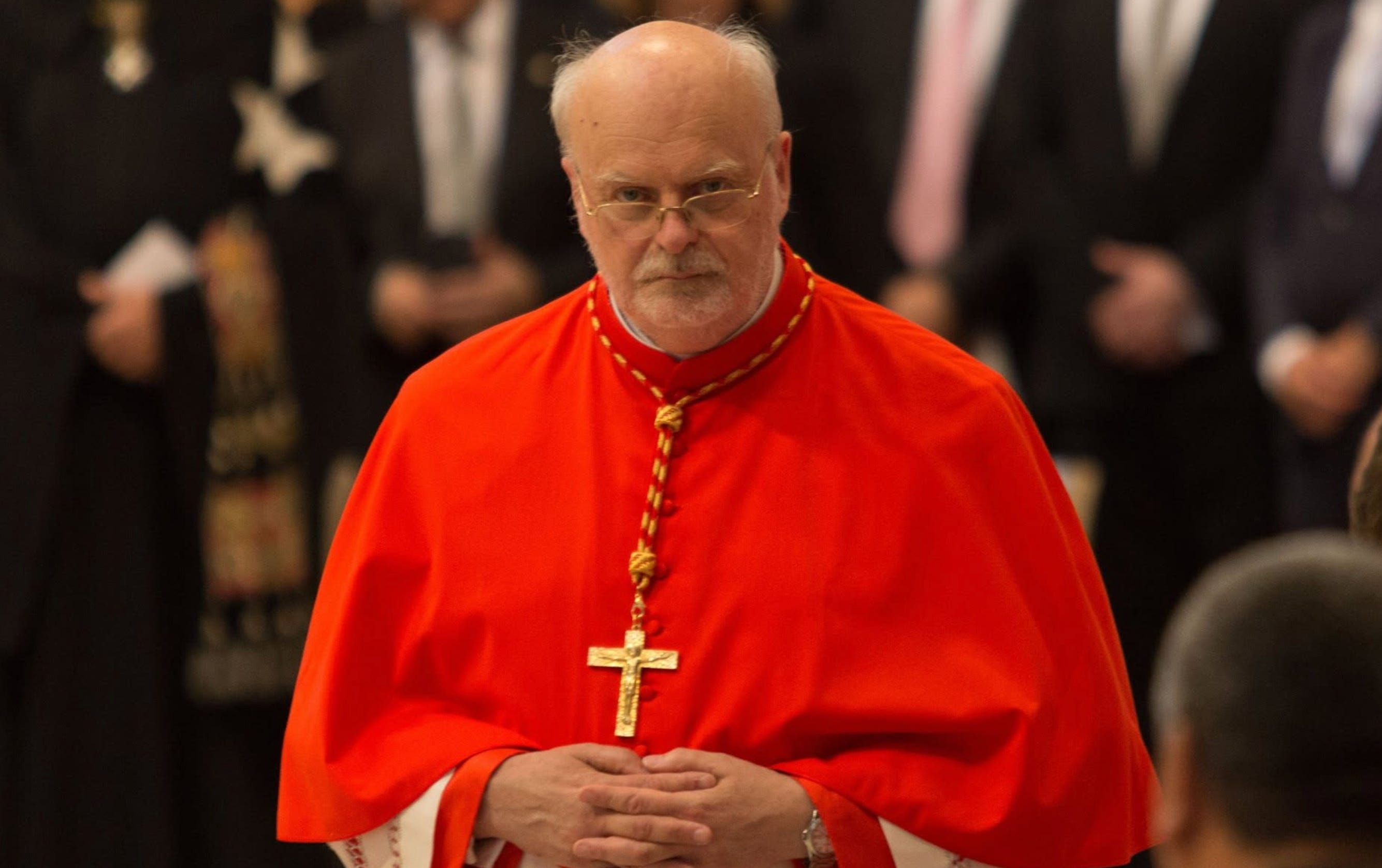
ROME, 26 June 2026 — In Hamlet, Shakespeare gave the line “Something is rotten in the state of Denmark” not to Hamlet the prince, nor to any man of power, but to Marcellus — an officer standing watch in the dark, perceiving a truth that those in authority could not or would not see. Today, across the water in Sweden, it is the lay faithful who are sounding the alarm, calling on Rome to investigate what they describe as corruption at the heart of the country’s only Catholic diocese.
The calls for an apostolic visitation to the Diocese of Stockholm follow the publication of a two-part investigation by Swedish Catholics. This journalist has both studied the report and independently corroborated its overall account, speaking with sources within the diocese not connected to the investigation. All confirm its portrayal of the diocese as “very accurate.” The diocese calls it “not serious.”
“We are desperate here,” said one priest, describing a climate of fear that exists particularly among diocesan clergy. The investigation describes a “power vacuum” at the top of the diocesan administration that has enabled an “axis of power” within the Chancery — one that, it alleges, has moved against those it perceives as disloyal or threatening. It is a dynamic Shakespeare understood well: when legitimate authority fails or is corrupted at the top, what rushes in to fill the vacuum is not order but its opposite.
The calls have grown more urgent as Cardinal Anders Arborelius, 76, approaches retirement and the diocese awaits the appointment of his successor.
This article, the first in a series, turns to the investigation’s central but not only case: that of Father Tobias Unnerstål, removed as parish priest of Christ the King parish in Gothenburg in January 2022, suspended from priestly ministry in November 2024, and never permitted to see the complaint that drove both actions.
Published in Swedish under the name “Thomas More” — and now available in English — the report was compiled over two years by a group of Catholics within the Diocese of Stockholm, drawing exclusively on first-hand sources, documentation, and testimony from hundreds of people across the diocese. Its subject, in the authors’ words, is a pattern of corrupt governance at the highest levels of the Stockholm Diocesan Chancery.
Its authors say they raised their concerns with the diocese on countless occasions and through proper channels. They were not alone: over the years, many others — clergy, parishioners, and individuals from across the diocese not connected to the report — brought their concerns directly to the diocese and to Cardinal Arborelius himself. They went unaddressed.
The report was first circulated among priests and lay members of the diocese in November 2025 before being made public in December. “To remain silent in this situation,” the authors write, “would mean accepting the diocese’s corrupt handling of matters like this, thus allowing more people to come to harm in the future.”
The Case of Father Tobias Unnerstål
Fr. Tobias Unnerstål served as parish priest at Christ the King Church in Gothenburg from 2007 to 2022 — fifteen years during which the parish flourished by every account. Under his care, the congregation grew, vocations grew, conversions multiplied, and a vibrant youth culture took root that became known throughout the diocese. He celebrated the Traditional Latin Mass, which drew young families and worshippers from across the region; at its height, the report says, some sixty per cent of those attending were children and young people. He was also a driving force behind a plan to establish an Oratory in Gothenburg on the model of St Philip Neri — a project endorsed in writing by Cardinal Arborelius and his Vicar General in October 2020 and reaffirmed by the Cardinal on 9 January 2022 — just eight days before Fr. Tobias’s dismissal. More than one priest who knew him told this journalist they had considered him a potential successor to Cardinal Arborelius.
On 15 February 2021 — the very same day that Fr. Tobias wrote to the Vicar General, Father Pascal-René Lung, OP, seeking guidance on how to proceed with the Oratory — a complaint of emotional, psychological and spiritual abuse was filed against him by Joseph Rizk, then a seminarian and now a priest of the diocese. Under canonical procedure, the complaint should have been communicated to Fr. Tobias within two months of being filed, giving him a couple of weeks to appeal. It was not. When he was finally summoned to Stockholm for questioning on 22 April 2021 — already past that deadline — he met alone with Fr. Pascal; the Cardinal was absent. Fr. Pascal read out excerpts from the complaint, but Fr. Tobias was never shown the document itself, and to this day the diocese has not provided it to him.
Three charges were read aloud. Each had an answer. Fr. Tobias was said to have isolated Rizk from the other altar boys by having him change in the sacristy rather than upstairs with the group — standard practice for older servers, Fr. Tobias explained, and after Rizk entered seminary he had been especially careful to maintain clear boundaries. He was also said to have given Rizk money: true, he acknowledged, but given at Rizk’s own explicit request, as the text messages between them showed. The third charge concerned a photograph from a 2009 altar-server trip to Malta, described in the complaint as “inappropriate”: a holiday snapshot of Rizk in swimming trunks with his shirt over his head like a hat. Fr. Tobias produced the same message thread to show he had sent the photo to Rizk himself, suggesting in jest that he use it as a Facebook profile picture. Fr. Pascal, in presenting the charges, stressed that nothing physically improper had been alleged between the two men at any time.
The meeting ended with an ultimatum: confess to the three charges or face suspension — which Fr. Tobias understood to mean he could no longer celebrate Mass. Believing he had no alternative, he complied. He subsequently retracted the admission in its entirety, stating that the interpretation placed on every point had been wrong.
Cardinal Arborelius, who was not present at the meeting, later issued what was termed a “fraternal warning” and placed him on sabbatical leave that autumn.
The Letter
What lends the case its more disturbing character is the role played by Birgitta Gelotte — a former parish assistant to Fr. Tobias, and a close friend of Rizk. As early as 2019, the report says, she was telling other clergy that Fr. Tobias was an alcoholic and a homosexual who had behaved improperly with a young man — claims multiple witnesses quoted in the report describe as untrue. (The report notes that she had made serious accusations against others in correspondence to the Cardinal, then withdrew them as “misunderstandings” after he accidentally forwarded one to the very people she had accused.)
In July 2021, she wrote and privately circulated her own account of the relationship, binding those with whom she shared it to secrecy. In the letter, she states her motive plainly: “Rumours had begun to spread that Fr. Tobias and Father Joakim wanted to start an Oratory — I knew I had to do everything I could to stop it.” She also describes spending years working to shift how Rizk understood his relationship with the priest: at first, he was surprised and denied her interpretation, she said, but “as the years passed” he eventually “came to share my view.” By her own account, she did not merely suspect a problem — she worked, over years, to construct one in Rizk’s mind.
The letter did not remain entirely private. That same month, she invited Maxim and Cecilia Jaruta — close friends — to her home for dinner; they arranged childcare so they could attend. Over the course of the evening, Gelotte read from the letter on her phone, telling them it was the most important thing she had to say. At the end of the evening, Maxim asked for a copy; Gelotte sent it to him by text message.
Maxim Jaruta, who goes on the record in the report, confirmed the account to this journalist. “I stand by what I said.”
A father of seven and parishioner at Christ the King for ten years, he said that nothing in that time had given him any reason to think the allegations were true — but he found them serious enough to raise with Fr. Tobias directly. He did so on 7 August 2021. Fr. Tobias denied every point, seemed to know — before Maxim revealed the author — that Gelotte had written the letter, and asked to see it; Maxim shared it with him, but with no one else.
One week later, on the eve of his sabbatical, Fr. Tobias met the Vicar General and had him read the letter in full. Fr. Pascal was reportedly “visibly pained” and implied that something would need to be done to correct Gelotte.
Gelotte would later tell Maxim that the Vicar General had telephoned her, alert to the letter’s existence, and warned her that Fr. Tobias was now aware of it.
That autumn, Maxim met with Monsignor Jorge de Salas, Episcopal Vicar for Juridical Affairs — whom he had known for several years — to discuss the matter. Msgr. de Salas appeared to be aware of the letter already but dismissed its significance: it was the text messages, he said, that could potentially put Fr. Tobias in prison. The diocese, however, had never reported the matter to the police, as far as Maxim knew — and he had no access to those messages, which made the claim all the harder to interpret.
Gelotte states in the letter that she raised her concerns about Fr. Tobias directly with Cardinal Arborelius. She also describes contacting the “diocese” to request permission to search the parish’s shared server for photographic evidence of what she alleged was an improper relationship between the priest and Rizk. Permission, she says, was granted. She found one image — a picture of sixteen-year-old Rizk shirtless in the summer heat in Malta during the altar-server excursion — which left her, in her words, “overwhelmed with incredible anger.”
The Dismissal
Fr. Tobias spent his sabbatical in the United States. He left believing the matter of Birgitta Gelotte’s letter would be addressed. While abroad, rumors of his dismissal began circulating.
He returned to Gothenburg in late December 2021. On 9 January 2022, the Cardinal wrote to him — reaffirming the Oratory project and, in the same letter, informing Fr. Tobias for the first time that “the Prosecutor’s Office” had declared the correspondence criminal. The reviewer — whose name the Cardinal had not disclosed — was Magnus Bolin, simultaneously a diocesan employee and a member of Fr. Tobias’s own congregation at Christ the King. The report calls the diocese’s failure to appoint a reviewer independent of both “questionable, not to say inappropriate.”
On Friday 14 January 2022, the Cardinal telephoned him to discuss a new assignment. Fr. Tobias did not want to leave his parish, but in the end acquiesced. He was told the Vicar General would contact him with the details. Fr. Pascal did so on Monday 17 January — but said nothing to suggest that Fr. Tobias’s removal from the parish would take effect that same day. Fr. Tobias learned of it the following morning, through a public announcement stating that his tenure as parish priest of Christ the King Church had ended. He was also stripped of his roles as dean, member of the priests’ council, and member of the diocesan council.
In an accompanying announcement, the Cardinal cast the removal as a new appointment. In the wake of Traditionis Custodes — Pope Francis’s July 2021 motu proprio restricting the old rite — and in light of Fr. Tobias’s “great pastoral experience and insight into the liturgical tradition,” he said he was entrusting him with a new mission: coordinator of the Traditional Latin Mass across the diocese.
His parishioners did not receive the news quietly. Within days, a petition gathered 457 signatures, accompanied by testimonials describing a priest of rare pastoral generosity — patient, selfless, someone who had remained at the church door long after Mass to speak with whoever needed him, who had helped people return to the faith. One signatory wrote that the congregation felt “orphaned” without him.
On 1 February, Fr. Tobias moved out of the parish. The same date marked the end of the Traditional Latin Mass at Christ the King.
Two weeks later, he met privately with the Cardinal in Stockholm to discuss the new role. Afterwards, the two went together to the Vicar General’s office, where the Cardinal instructed Fr. Pascal to provide Fr. Tobias with a company car, a credit card, and a budget for the work. The first two arrived. The budget never did.
Then, on 24 February 2022, the Cardinal issued a decree that was not made public. It barred Fr. Tobias from working with children and young people, stated that it could not be appealed, and was to be disclosed only to those the Cardinal judged needed to know.
Fr. Tobias was not, however, removed as TLM coordinator. At a meeting with the Cardinal and Vicar General on 29 March, the scope of the decree was clarified: he could continue to celebrate Mass and hear confessions only within the TLM community, including for minors — but he was not permitted to teach catechism or organize summer camps. The diocese had formally barred him from ministry to children and young people. It had not removed him as coordinator of a community whose core was precisely those families, children and young people.
Six months later, the diocese moved again. On 19 October 2022, it announced that Fr. Tobias had been “relieved of his ordinary pastoral duties in the Catholic Diocese of Stockholm,” effective 1 October. Fr. Tobias learned of the announcement when a friend telephoned to ask what it meant.
He requested a meeting with the Cardinal to clarify the matter but received no response. Damiano Ognissanti, a layman and father of eight, wrote to the Cardinal to ask whether Fr. Tobias was still permitted to celebrate the Traditional Latin Mass on Sundays; Mother Maria of the Annunciation OCD, then Prioress of the local Carmel, asked whether he could hear confessions for the Sisters; Father Dominik Terstriep SJ, pastor of the Jesuit parish in Stockholm, asked whether he could participate in a parish evening on the Traditional Latin Mass. Each was told there was no impediment.
Fr. Tobias then engaged a criminal defense lawyer, Andreas Stenkar Karlgren, who secured a meeting with the Cardinal and Vicar General in January 2023. At that meeting it was confirmed that the restrictions applied only to the celebration of Mass and the administration of the sacraments in the Novus Ordo. Stenkar Karlgren had also been asked to examine Fr. Tobias’s entire text message correspondence with Rizk. His conclusion was unambiguous: “There is absolutely nothing criminal in this.”
The psychological evidence pointed in the same direction. Between 2023 and 2024, Per Magnus Johansson — a prominent psychologist and psychotherapist renowned in his field in Sweden — conducted a full assessment of Fr. Tobias and reviewed a portion of the text messages. He found the relationship between the two men to have been close, trusting and mutual. He saw no reason to prevent Fr. Tobias from continuing priestly ministry, and recommended the diocese arrange a supervised conversation between the two men. No such conversation was arranged and the diocese’s position did not change.
The Suspension
For the next two years, Fr. Tobias carried on in his role as he understood it, ministering to several TLM communities and the Carmelite nuns. Then, on 10 November 2024, the Cardinal issued a formal decree suspending him and revoking all his faculties; the news was published on the diocesan website the next day.
The decree cited three grounds: a “Rehabilitation Plan” drawn up in January 2023 that had, in the Cardinal’s words, “not been able to be completed as I wished”; unspecified “shortcomings in his current pastoral ability”; and an allegation that the February 2022 prohibition on working with children and young people “has not been fully respected.” The decree made no mention of emotional exploitation — a characterization that would not feature in any public communication until months later. On 14 November, Fr. Tobias filed a remonstratio with the Cardinal, formally contesting the grounds of the decree.
On 10 December 2024, he brought a civil action against the diocese in the Stockholm District Court, seeking annulment of his dismissal and damages. Fr. Tobias did not get the chance to test his evidence at trial. Court records show that the diocese, “in order to resolve the dispute,” formally admitted his claims and their grounds. The case was decided on 10 June 2025 under a Swedish procedural rule allowing judgment where a defendant concedes a claim outright, without a main hearing. The diocese was ordered to pay Fr. Tobias roughly 240,000 kronor (approximately €21,700) in damages, plus legal costs. On 2 July — before it had said anything publicly about the outcome — the diocese terminated Fr. Tobias’s employment and stopped his salary.
The diocese’s response to the judgment was not to acknowledge that it had lost. On the contrary: its public statement, headlined “Civil legal proceedings concluded: priest’s employment ends and suspension remains in place,” made no mention anywhere that the court had found in Fr. Tobias’s favor, annulled his dismissal, or ordered damages to be paid. His departure was described in the passive language of employment law — his contract had “ended… in accordance with the provisions of the Employment Protection Act” — and the court-ordered damages were referred to only as “a limited lump sum in accordance with the law,” as if they were a routine severance payment rather than the product of a court judgment the diocese had chosen not to contest.
Then, having said nothing about losing the case, the diocese used the occasion to go further than it ever had in its public characterization of Fr. Tobias. It itemized in granular detail every priestly act the suspension forbade him from performing and described the underlying concern — for the first time in any public communication — as “emotional abuse of an adult individual that is alleged to have taken place since the affected person was a minor.”
That characterization is considerably starker than anything formally put to Fr. Tobias at his April 2021 interrogation. Like those points, it has never been accompanied by a formal charge, disclosed evidence, or any opportunity for him to respond. The diocese had just lost in court; its public statement left the reader with a darker picture of Fr. Tobias than any it had published before.
The ruling became final on 25 July 2025. In November 2025, Fr. Tobias was given one month to vacate his official residence.
Throughout the entire process — spanning more than four years from the initial complaint to the civil court ruling — Fr. Tobias was never shown the charges against him, never provided with a formal decree setting them out, and never given a meaningful opportunity to confront the evidence the diocese claimed to hold. His canonical lawyer’s assessment was unsparing: if the diocese had followed proper procedure, it would not have needed to pay damages to avoid disclosure. What the case ultimately placed in question, he observed, was not merely justice for one priest, but the integrity of canon law itself — the very framework the Church professes to uphold.
The Dicastery’s Decision
In September 2025, Fr. Tobias formally sought recourse before the Dicastery for Clergy in Rome. The review concluded on 5 May 2026, when the Dicastery — of which Cardinal Arborelius is himself a member — issued its own decree. It determined that the November 2024 suspension had been imposed without the correct procedure and was therefore “invalid.”
The Dicastery did not, however, restore Fr. Tobias to unrestricted priestly ministry. Citing undisclosed “documentation at hand,” it imposed restrictions to remain in force for three years. According to the decree, that documentation included concerns raised by Cardinal Arborelius about Fr. Tobias’s “behavior with men.”
The Dicastery argued the restrictions were justified also based on “canonical warnings and pastoral interventions that, in the mind of the [Cardinal] and the Dicastery have not born fruit” — as well as the notoriety of the case in Sweden, and the “risk of scandal.” On that basis, it restricted Fr. Tobias from celebrating Mass publicly — unless concelebrating with his local Ordinary, i.e. the Cardinal — and revoked his faculties to hear confessions and to preach.
It also rejected the diocese’s argument that the court-ordered damages it paid following the loss of the civil case had satisfied its canonical obligation to provide for him. Fr. Tobias remains entitled, the Dicastery ruled, to ongoing support separate from any civil damages.
To date, the “documentation at hand” has not been disclosed to Fr. Tobias, and it is not known whether the Dicastery intends to provide it. The restrictions thus rest on material he has never seen and therefore cannot challenge — a fact that strikes sources close to the Dicastery for Clergy as the most fundamental violation of the process the Church’s own law requires.
He may appeal the decree to the Apostolic Signatura — which, sources familiar with its recent record say, has often overturned the Dicastery for Clergy’s rulings.
Father Tobias’s Successor
Fr. Tobias’s removal left Christ the King in need of a new parish priest. Father Johan Lindén OP served in that role on an interim basis in the months that followed. In October 2022, on the recommendation of Fr. Lindén, Cardinal Arborelius appointed Father Pär-Anders Feltenheim — putting him in charge of one of the diocese’s largest and most active parishes. The Thomas More report devotes an entire section to his history: a decades-long documented record of complaints about his conduct toward young people that followed him through every assignment he subsequently held — from his years as a political activist before ordination through three successive parishes and Stockholm Cathedral. The report assembles personal testimony from dozens of individuals — school classmates, political colleagues, youth leaders and parishioners — spanning three decades and entirely separate contexts, all of whom arrived at the same account.
The most significant episode in that record took place in 2013–14, when Fr. Pär-Anders was serving as a new chaplain at Our Saviour’s Congregation in Malmö. Complaints about his behavior toward young people prompted a formal investigation conducted by Msgr. de Salas, who traveled to Malmö and spoke directly with those affected. He was thus directly aware of what had happened, including the departure of several young people from the parish as a result. The investigation led to Fr. Pär-Anders’s immediate transfer to Stockholm Cathedral and to an express prohibition on his working with children and young people. Despite that prohibition, he subsequently became responsible for the Cathedral’s altar server group — consisting, the report notes, of boys in their early teens.
Cardinal Arborelius appointed Fr. Pär-Anders parish priest of the Mother of Christ Parish in Umeå in 2019. Testimonies from that period describe denial of sacraments without reason, slander of fellow priests, and the punishment and exclusion of parishioners who questioned him. Three years later — in the same month that Fr. Tobias was formally dismissed from regular pastoral service — the Cardinal promoted Fr. Pär-Anders to Christ the King. By that point, the report says, Cardinal Arborelius, Vicar General Fr. Pascal-René Lung and Msgr. de Salas were all aware of Fr. Pär-Anders’s history and the complaints that had followed him from parish to parish. Testimonies from his time in Gothenburg describe the “stalking of young people on social media” and an “alcohol incident” on a confirmation trip that resulted in a police report.
In early autumn 2025, Fr. Pär-Anders was finally summoned to a meeting at the Chancery with the Cardinal and Vicar General; due to scheduling conflicts, the meeting took place in early November. According to a well-informed diocesan source, at the meeting Fr. Pär-Anders was confronted with allegations regarding internet activity that, while not criminal in nature, were judged incompatible with his continuing as a parish priest. He was stripped of his duties and effectively placed on paid leave. The diocese gave him a quiet exit.
Shortly afterwards, Cardinal Arborelius wrote to the parish community at Christ the King. His letter, dated 4 November, was read aloud at the 11 a.m. High Mass on 9 November and published on the parish Facebook page the following morning. It expressed his “deep gratitude” to Fr. Pär-Anders for serving “with zeal and great commitment” in a role that had “often presented him with difficult and burdensome challenges.” As he had been “in danger of becoming burnt out,” the Cardinal had granted him “a sabbatical to allow him to recover and regain his strength.” The Chancery meeting, the allegations, and the removal of his duties were not mentioned.
Comments from the Stockholm Chancery
This journalist reached Msgr. de Salas, Episcopal Vicar for Juridical Affairs, by telephone. Asked first about Fr. Tobias’s successor at Christ the King, he confirmed that Fr. Pär-Anders — then on sabbatical — was a priest in good standing. So, if a parishioner wished to make an appointment with him for confession, would that be alright?
“Why not?” he replied.
This journalist noted that the same would not apply to Fr. Tobias — whose name Msgr. de Salas had already raised.
“That’s different,” he said.
Asked then about Fr. Tobias’s current status, Msgr. de Salas was precise: “He’s not suspended, strictly, but he’s not in good standing: he cannot go to another diocese to work as a normal priest, because he has the restrictions.” The substance of the Dicastery’s decree was confirmed: Fr. Tobias “cannot celebrate Holy Mass with people, cannot hear confessions for three years, cannot preach.”
Asked whether the diocese had conducted an investigation before the allegations were ever presented to Fr. Tobias, Msgr. de Salas said only that the diocese had conducted “a proper investigation” — but that it was “not for the media. It’s only for us and for the Vatican.”
When this journalist raised the name of Birgitta Gelotte and began to describe her admission that she had spent years shaping the accuser’s complaint, Msgr. de Salas — clearly having grasped the reference to the “Thomas More” report — cut across before the sentence was finished. The allegations were “anonymous,” driven by “a lot of anger,” he said.
He also said they were “false.” He insisted it was not a “serious” report “for a journalist or for anybody.” Pressed further, he replied: “No, no, it’s not serious. It’s not serious. It’s not serious. If you don’t understand that…” He had many things to do, he said. He was not at his office. The call ended.
A Pattern of Governance
For Catholics in Sweden who are calling for an apostolic visitation to the Diocese of Stockholm, these are not isolated failures — they are the character of governance in this diocese: one priest stripped of his ministry without ever seeing the complaint against him; another retained despite a documented record spanning three decades, and quietly retired with a letter of commendation.
Having studied the investigative reports and consulted informed sources within the diocese, the case of Father Tobias Unnerstål and of his successor is only the first chapter of a longer chronicle.
In his first soliloquy, Hamlet could not say aloud what he knew — he could only think it, alone, in anguish. Surveying the kingdom of Denmark, he saw not a realm but a neglected garden: “’Tis an unweeded garden, that grows to seed; things rank and gross in nature possess it merely.”
Marcellus stood his watch for a single night. The Catholics of Sweden have been standing theirs for years. Heaven, they trust, will direct it.
A great piece of journalism. Thank you. It makes me wonder what made Galotte so determined to destroy Fr Tobias - did he refuse her advances? And the duplicitous way in which the Francis-appointed Cardinal used her unsubstantiated characterisation of Fr Tobias to undermine him and all his good work, including building a vibrant Catholic parish with the TLM, is despicable.
Evil is the word for it - there is no other.
The whole world is Sweden, truth be told. Abuse of power, of the law, lack of due process, unfounded allegations, civil law suits, suspension... The legal process has been weaponized against priests and even laity who are deemed inconvenient, to put it mildly. The perpetrators of these injustices have no fear of God's judgment. Only God can deliver the Church everywhere from this abuse of power. The victims are legion.