
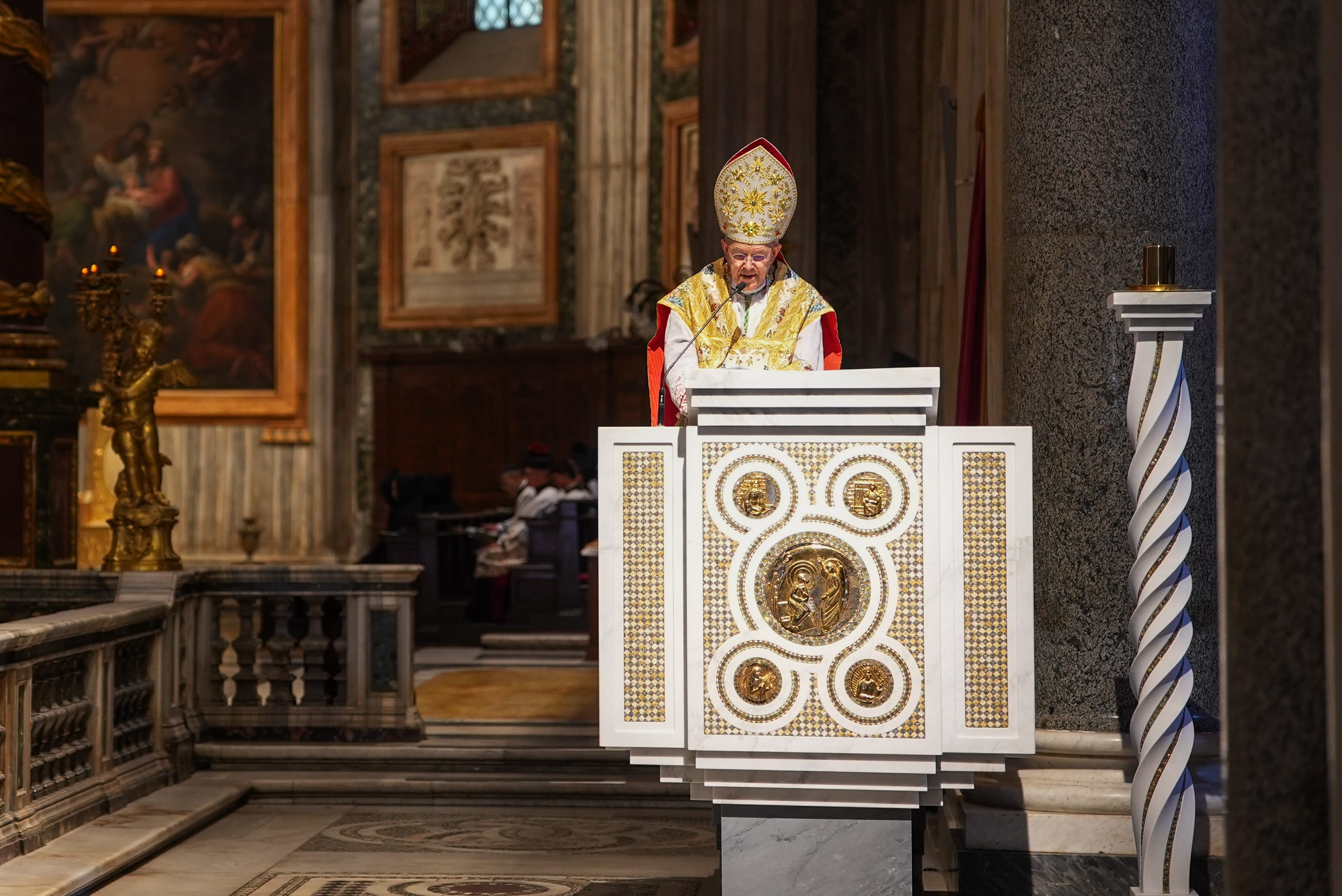
ROME, 26 October 2026 — Bishop Athanasius Schneider has called for an end to the marginalization of Catholics attached to the traditional Roman Rite, appealing for lasting liturgical peace so that the faithful might once again experience the Church of Rome as their Mother.
He made the appeal in a homily delivered on Saturday, Oct. 24, during the Summorum Pontificum pilgrimage Ad Petri Sedem, at the Basilica of St. Mary Major, where he offered Mass for the repose of the soul of Pope Francis, who is buried there. The Marian basilica is also the burial place of St. Pius V, who solemnly guaranteed the free and perpetual use of the traditional Roman Rite.
Preaching on the traditional feast of St. Raphael the Archangel, Bishop Schneider suggested what Pope Francis might now say to his successor and the bishops: “Restore and preserve the pristine and very beautiful form of the Roman Rite, canonized by St. Pius V.” He also recalled that this was the Mass of Francis’s youth and conversion, as well as the Mass of Pope Leo XIV’s childhood and First Communion.
Read the official English text of Bishop Schneider’s homily below.
Homily of Bishop Athanasius Schneider
Holy Mass, Summorum Pontificum Pilgrimage Ad Petri Sedem
24 October 2026, Basilica of Saint Mary Major, Rome
Praised be Jesus Christ! Dear brothers and sisters in Christ! The Holy Church, the Chair of Saint Peter, is our Mother. We are children of the Church, and this is why the expression “Holy Mother Church” is so dear to all true Catholics. The Church is a mother because there is another Mother, that one Mother who is immaculate, who is ever virgin: she is the Most Holy Virgin Mary, Mother of God and our Mother.
We have the great joy of being able to celebrate, at this moment and in this basilica — in the house of our Mother — the Holy Mass according to the same venerable form in which so many popes and countless generations of priests have celebrated it in this place. Here several saints and popes celebrated their first Holy Mass, such as Saint Ignatius of Loyola and Pope Pius XII.
Pope Francis had a particular devotion to the icon of the Salus Populi Romani kept in this basilica. He chose this very basilica as the place of his final earthly resting place. Over the twelve years of his pontificate, Pope Francis prayed before the icon of the Salus Populi Romani one hundred and twenty-six times. His first visit took place on March 14, 2013, the day after his election; the last, a week before his death. He made these visits before and after every apostolic journey, as well as during his four hospital stays at the Gemelli Polyclinic. Seven other popes are buried in the basilica.
Indeed, this basilica and the traditional form of the Mass of the Roman rite are linked to Saint Pius V, whose holy body rests here. He is the Pope who has gone down in history as the pontiff of the traditional Roman rite and of the Holy Rosary. Thanks to the prayer of the Rosary, Christians won the victory over the enemies of Christendom at Lepanto, against all human expectation.
Saint Pius V did not undertake a reform of the rite of the Mass in the strict sense, for he had a profound respect for the liturgical tradition of the Church of Rome. For centuries, the Church of Rome had possessed a rite which, by virtue of its doctrinal integrity, ritual beauty, and maturity, required no reform, but on the contrary served as a guarantee and a sure point of reference amid the widespread liturgical anarchy of the sixteenth century, brought about by the Protestant pseudo-reforms.
Drawing on this venerable tradition its sacredness, Saint Pius V guaranteed — in a particularly solemn manner, by the apostolic constitution Quo Primum — the free and perpetual use of the traditional form of the Mass to all priests of the Roman rite. He expressly established that no priest could ever be compelled to celebrate the Holy Mass according to a form other than that of the missal he had promulgated, and that his apostolic constitution Quo Primum could not be revoked in the future. Thus, St. Pius V, in a certain sense, canonized the traditional rite of the Mass. Consequently, no Roman pontiff has ever dared to revoke or “de-canonize” Quo Primum, a fact acknowledged by Pope Benedict XVI, who affirmed that this form of celebrating the sacrifice of the Mass had never been abrogated (cf. Apostolic Letter Summorum Pontificum of 7 July 2007).
We are in a basilica that also houses the statue of the Mother of God under the title “Queen of Peace,” placed there at the behest of Pope Benedict XV. The Virgin Mary, Queen of Peace, is seated on a throne holding the Child Jesus, who is poised to let the olive branch fall. The Virgin’s face expresses sorrow and sadness, and with her raised arm, she implores an end to hostilities. On the pedestal, a dove waits anxiously for the olive branch to fall so it may carry the message of peace to mankind. A great number of Catholics worldwide — particularly the younger generation and young families —harbor a legitimate desire to participate in Holy Mass in the traditional form.
Pope John Paul II regarded the faithful’s desire for this liturgical form as legitimate, urging bishops to respond generously to it (see Apostolic Letter Ecclesia Dei). Through this liturgical form, the faithful seek to unite themselves spiritually with the saints and their own ancestors; they desire to experience—with eyes, ears, and heart—that ritual form of the Mass which nourished and strengthened so many saints, martyrs, and confessors in their Christian lives. Yet today, due to rigid regulatory restrictions and pastoral discrimination, these faithful — especially the young — feel treated as second-class Catholics. Nevertheless, they harbor no bitterness; instead, they continue to love their Mother, the Church, even if, for the moment, they do not feel understood by that very Mother—by the Church of Rome.
If the Lateran Basilica is the “Mother and Head of all the churches of the City [Rome] and of the world,” the Basilica of Saint Mary Major is the “Mother and Head of all the Marian shrines of the world.” May the saints and popes who have a particular bond with our Marian Shrine implore the Mother of God—the Salus Populi Romani and Regina Pacis—to obtain for us the grace that the olive branch held in the hand of the Child Jesus in the arms of the Regina Pacis may fall upon us and bring us the longed-for liturgical peace: a peace that would restore the full use, without discrimination, of the traditional form of the Roman Rite.
May those in positions of responsibility in the Church foster the coming of such liturgical peace, allowing themselves to be touched by the voice of the Regina Pacis and of the Church’s smallest children, who have been marginalized in the liturgical sphere. May they be mindful also of these words of John Paul II: “In the Roman Missal, known as that of Saint Pius V … there are very beautiful prayers with which the priest expresses the most profound sense of humility and reverence before the holy mysteries: they reveal the very substance of any Liturgy” (Message to the participants in the Plenary Assembly of the Congregation for Divine Worship and the Discipline of the Sacraments, 21 September 2001).
May they likewise bear in mind those of Pope Francis, who praised the Orthodox Churches for having preserved their “pristine” and “very beautiful” liturgy, saying: “We have lost some of the sense of adoration. The Orthodox preserved it; they praise God, they adore God, they sing, time does not matter. God is at the centre, and … that this is a richness.” (Press conference on the return flight from the apostolic journey to Brazil, 28 July 2013). Today Pope Francis might perhaps say to his successor and to the bishops: “Restore and preserve the pristine and very beautiful form of the Roman Rite, canonized by Saint Pius V.” This form of the Mass was that of Pope Francis’s youth and was the Mass of his conversion. This form of the Mass was that of the childhood and First Communion of Pope Leo XIV.
O Mary, Mother of God, O Salus Populi Romani, O Regina Pacis, bring us the olive branch from the hand of the Child Jesus, heralding the coming of liturgical peace, which will ensure the full and free use of the traditional Roman Rite, so that we may once again experience that the Church of Rome is our Mother. Amen.
+ Athanasius Schneider, Auxiliary Bishop of St. Mary in Astana
My Substack is sustained entirely by you, its readers. Your support doesn’t just keep it going — it makes possible the kind of reporting, analysis and independence that would be difficult to maintain otherwise. I’m deeply grateful to those who choose to become paid subscribers (below) or support this work by donating here:
God bless the Bishop, a good reminder to us to pray for the soul of Pope Francis as well espcially as All Souls Day is coming up and the Octave of indulgences and month of prayers for the dead. I'd love to meet Bishop Schneider one day, I've twice missed in when he visited England... maybe one day. It'd be nice to meet such a holy man.
I wondered how the SP pilgrimage would handle Pope Francis' tomb being right at their elbows during Mass. Bishop Schneider is a class act. Thank you Bishop.